Showing posts with label Carnivore. Show all posts

Great Plains Wolf

  
The Life of Animals | Great Plains Wolf | The Great Plains wolf (Canis lupus nubilus), also known as the Buffalo wolf, is the most common subspecies of the gray wolf in the continental United States. Like all wolves, the Great Plains wolf is a very social animal that communicates using body language, scent marking and vocalization with an average pack size of five to six wolves.


The territory size for the Great Plains wolf depends on the type and density of prey. The historic range of the Great Plains wolf was throughout the United States and the southern regions of Canada. In Wisconsin and Michigan, the Great Plains wolf was eradicated by the mid- 1960s. 


In 1974, the Great Plains wolf in the Great Lakes region became fully protected as an endangered species. By 1978, Minnesota's wolf population had increased enough that the wolf was reclassified as threatened in Minnesota. The estimated population for Great Plains wolves for 2004 in the United States was over 3,700 wolves. Minnesota 3,020 


Eastern Wolf

  
The Life of Animals | Eastern Wolf | The Eastern Wolf (Canis lycaon), also known as Eastern Canadian Wolf or Eastern Canadian Red Wolf, may be a subspecies of gray wolf (Canis lupus lycaon) or a distinct species of canid native to the eastern part of North America since the Pleistocene era It seems to be closely related to the Red Wolf. Many names were proposed, including the Eastern Wolf, Eastern Gray Wolf, Eastern Timber Wolf and Algonquin Wolf, although Eastern Wolf has appeared to gain the most recognition.


Eastern Wolf was recently recognized as a potentially distinct species, but closely related to red wolf Some authors disagree and the status as a distinct species is not official. The Eastern Wolf is smaller than the Grey Wolf and has a grey-reddish coat with black hairs covering the back and sides of the thorax. The mtDNA analysis confirms that eastern wolf belonged to an ancient form of primitive wolf (with red wolf) originating some 750,000 years ago in the eastern part of North America (Nowak 1979, 1992). On March 31, 2010, a presentation by Ontario Ministry of Natural Resources research scientist Brent Patterson outlined key findings about the Eastern Wolf (and coyotes): Most coyotes in Eastern Ontario are wolf-coyote hybrids; wolves in Algonquin Park are, in general, not inter-breeding with coyotes; and the buffer zone around Algonquin Park is a great success with mortality rates down and populations remaining stable.


Proponents of distinct species designation believe that the Eastern Canadian Wolf is just the remnant northern range of a once continuous range of a native canid - the Eastern wolf (E.C. w & Red Wolf). Unlike the Gray Wolf, the Eastern Wolf in Algonquin Park has never been recorded with an all-black or all-white coat (wolf research in Al. P. cited 2008). Eastern wolf mainly exist in Algonquin Park in Canada-USA border. The Eastern Wolf is smaller than the Gray Wolf. The Eastern Wolf is also skinnier than the Gray Wolf and has a more coyote-like appearance. This is because wolves and coyotes often mate and breed wolf/coyote hybrid pups in the park. 


The Canadian Parks and Wilderness Society states: "Hybridization with coyotes has historically been a precursor to the decline of Eastern wolf populations. Grey wolves will attack, kill or drive out coyotes if they find them, but recent studies by John and Mary Theberge suggest that Algonquin wolf males mate and accept coyote females. John Theberge states that, because coyotes are smaller than wolves, that female wolves would be less likely to accept a smaller mate.


However, on March 31, 2010, a presentation by Ontario Ministry of Natural Resources research scientist Brent Patterson outlined key findings about the Eastern Wolf (and coyotes): Mostcoyotes in Eastern Ontario are wolf-coyote hybrids; wolves in Algonquin Park are, in general, not inter-breeding with coyotes; and the buffer zone around Algonquin Park is a great success with mortality rates down and populations remaining stable In Canada, exact numbers of Eastern Canadian Wolves are unknown. In Algonquin wolves often travel outside the park boundaries, and enter farm country where some are killed. The Eastern Wolf preys on white-tailed deer, moose, lagomorphs, and rodents including beaver, muskrat, and mice.

Eurasian Wolf

  
The Life of Animals | Eurasian Wolf | The Eurasian Wolf (Canis lupus lupus), also known as the, European, Common or Forest Wolf is a subspecies of grey wolf which has the largest range among wolf subspecies and is the most common in Europe and Asia, ranging through Mongolia, China, Russia, Scandinavia, Western Europe and the Himalayan Mountains. Compared to their North American cousins, Eurasian wolves tend to have longer, more highly placed ears, narrower heads, more slender loins and coarser, tawnier coloured fur. Compared to Indian wolves, Eurasian wolves are larger, and have longer, broader skulls. In Europe, wolves rarely form large packs like in North America, as their lives are more strongly influenced by human activities. Because of this, Eurasian wolves tend to be more adaptable than North American wolves in the face of human expansion.


Comparative studies on the Mitochondrial DNA of various wolf subspecies have shown that the European line of wolves originated over 150,000 years ago, making them around the same age as North American wolves, but significantly younger than Asiatic subspecies.Comparative studies on the Mitochondrial DNA of various wolf subspecies have shown that the European line of wolves originated over 150,000 years ago, making them around the same age as North American wolves, but significantly younger than Asiatic subspecies.


The size of Eurasian wolves is subject to geographic variation with animals in Russia and Scandinavia being larger and bulkier than those residing in Western Europe, having been compared by Theodore Roosevelt to the large wolves of north-western Montana and Washington. One wolf killed in Romania was recorded to have weighed 72 kilograms (158 pounds) Italian wolves, excepting the tail, body length ranges between 110–148 cm, while shoulder height is 50–70 cm. Males weigh between 25–35 kg (55-77 lbs) and rarely 45 kg (99 lbs) The now extinct British wolves are known to have reached similar sizes to Arctic wolves.


The guard hairs of the shoulder measure 90 mm, but can reach 110–130 mm Wolves in Southern Europe tend to be more richly coloured than their northern relatives. Black coloured wolves (which result from wolf-dog hybridisation) are rarer in Eurasia than in North America due to wide spread reduction in wolf numbers preventing wolves from interacting with dogs, though currently 20-25% of Italy's wolf population is composed of black animals. Because of widespread habitat reduction and displacement of large prey, European wolf packs are usually smaller than North American ones, and generally form territorial ranges of 100–500 km², as opposed to North American packs whose territories encompass 80-2,500 km². Because of their longer association with urban civilisations, Eurasian wolves tend to be more adaptable than North American wolves in the face of human expansion; Southern European wolves successfully live in areas with much higher human densities than what North American wolves will tolerate. Unlike wolves in North America, many Eurasian wolf populations are forced to subsist largely on livestock and garbage in areas with dense human activity, though wild ungulates such as moose, red deer, roe deer and wild boar are still important food sources in Russia and the more mountainous regions of Eastern Europe. In the Białowieża Forest, wolves primarily feed on red deer; 75% of red deer mortality there was attributed to wolf predation. Although properly regulated wolf harvests and control have been largely accepted as compatible with maintaining wolf numbers to economically acceptable levels, overhunting and poaching are recognised as the main limiting factor in European wolf populations. With the exception of Russia, European wolf populations number 18,000-25,000.


Mexican Wolf


The Life of Animals | Mexican Wolf | The Mexican Wolf is the smallest Gray Wolf subspecies present in North America. Until recent times, the Mexican Wolf ranged the Sonoran and Chihuahuan Deserts from central Mexico to western Texas, southern New Mexico, and central Arizona. Hunters also hunted down the wolf because it killed deer. Trappers and private trappers have also helped in the eradication of the Mexican Wolf. (Note that recent studies completed by genetics experts show evidence of Mexican Wolves ranging as far north as Colorado). In 1976, the Mexican Wolf was declared an endangered subspecies and has remained so ever since. Today, an estimated 340 Mexican Wolves survive in 49 facilities at the United States and Mexico.


In March 1998, the United States Fish and Wildlife Service (USFWS) began reintroducing Mexican Wolves into the Blue Range area of Arizona. The overall objective of this program was to reestablish 100 Mexican Wolves in the Apache and Gila National Forests of Arizona and New Mexico by 2008.


On March 30, 1998, government biologists released 11 gray wolves 3 adult males, 3 adult females, 3 female pups and yearlings and 2 male pups from 3 chain-link acclimation pens within the 18,130 square kilometres (7,000 sq mi), federally designated Blue Range Wolf Recovery Area in east-central Arizona.


In February 2010, three captive Mexican Wolves living in the Wildlife Science Center in Forest Lake, Minnesota escaped from their pen after it was pried open by unknown individuals. The Center is the third largest breeding and host facility for Mexican gray wolves in the United States


Arabian Wolf

  
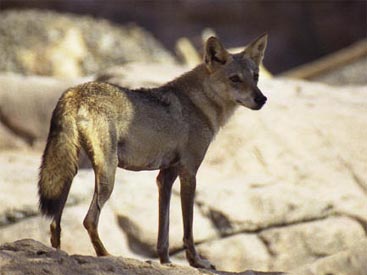
The Life of Animals | Arabian Wolf | The Arabian wolf (Canis lupus arabs) is a subspecies of Gray Wolf which was once found throughout the Arabian Peninsula, but now only lives in small pockets in Southern Israel, Southern and western Iraq, Oman, Yemen, Jordan, Saudi Arabia, and probably in some parts of the Sinai Peninsula in Egypt.


The Arabian wolf is a small, desert adapted wolf that stands at around 26 inches shoulder height and weighs an average of 40 pounds Their ears are proportionally larger in relation to body size when compared to other species, an adaptation needed to disperse body heat. The winter coat is long, though not as long as northern subspecies  Arabian wolves are unique among grey wolves due to the middle two toes of their paws being fused, a trait originally thought unique to the African Wild Dog  It is distinguished from the Indian Wolf by its paler fur, smaller size and proportionally smaller head


Arabian wolves will attack and eat any domestic animal up to the size of a goat. Arabian wolves also feed on hares, rodents, ungulates, and any carrion they can find. In Israel, there are between 100 and 150 Arabian wolves all over the Negev and the Arava. 


Tundra Wolf


The Life of Animals | Tundra Wolf | The Tundra Wolf (Canis lupus albus) is a subspecies of Gray Wolf native to the tundra and forest zones in the European and Asian parts of Russia and Kamchatka. Although often written to be larger than forest wolves, this is untrue, as heavier forest wolves have been recorded. Average weight for males is 40-49 kg (88-108 lb). Females average 36.6-41 kg (81-90 lbs).


The fur is very long, dense, fluffy and soft. The top hairs are 150-160 mm, the guard hairs 80-150 mm and the underfur 70 mm. The fur is usually light and grey in colour. 


It rarely forms permanent territories, travelling 200-300 km annually to accompany reindeer migrations. Reindeer losses to tundra wolves can be considerable for the Nenets people, who rely on them for subsistence; in the Yamalo-Nenets Autonomous Okrug, 1708 reindeer were killed by tundra wolves in 1951, and 7048 others were scattered. In the decade between 1944-1954, tundra wolves killed 75,000 reindeer


Arctic Wolf


The Life of Animals | Arctic Wolf | The Arctic Wolf (Canis lupus arctos), also Called Polar Wolf or White Wolf, is a species of mammal of the Canidae family, and a subspecies of the Gray Wolf. Arctic Wolves inhabit the Canadian Arctic, Alaska and the northern parts of Greenland. The Arctic Wolf inhabits the northern part of Greenland, the Canadian Arctic and parts of Alaska. Arctic wolves live on the islands of the Canadian Arctic, and the north coast of Greenland, roughly north of 70 ° North latitude.


The Arctic Wolf can withstand the arctic weather. Arctic Wolves usually travel in packs of 2 to 20. They live in small family groups: a breeding pair (alpha male and female) and Their pups. Lone Arctic Wolves are young males have left That Their pack to seek Their own territories. Having found an abandoned territory, a lone Arctic Wolf Will claim it by marking the territory with its scent, then gather other lone wolves into its pack. When the female is pregnant, She leaves the pack to dig a den to raise her pups. Like all wolves, Arctic Wolves hunt in packs, preying on caribou and muskoxen Mainly, but also Arctic Hares, seals, Ptarmigan and lemmings, and Smaller animals Such as Waterfowl To eat rodents Their They must pick up the scent and find the entrance to Their tiny dens to flush them out.


Wolves almost never attack Humans. Adult wolves have 42 teeth, Their main weapon in hunting. They swallow food in large chunks, barely chewing it. Wolves can eat up to 20 pounds (9 kg) of meat at one meal. When They return from the hunt, wolves regurgitate some of the food for the hungry pups

Due to the Arctic's permafrost soil and the difficulty it poses for digging dens, Arctic Wolves Often use rock outcroppings, caves or even shallow depressions as dens instead. Other wolves in the pack may take care of the mother's pups until She returns with food.

Nile Crocodile

  
The Life of Animals | Nile Crocodile | The Nile crocodile or Common crocodile (Crocodylus niloticus) is an African crocodile which is common in Somalia, Ethiopia, Uganda, Kenya, Egypt, Tanzania, Zambia, Zimbabwe,Gabon, South Africa, Malawi, Sudan, Botswana, and Cameroon. Isolated populations also exist in Madagascar, Senegal.


In antiquity, Nile crocodiles occurred in the Nile delta and the Zarqa River (Jordan), and they are recorded by Herodotus to have inhabited Lake Moeris. It is known from fossil remains that they once inhabited Lake Edward  The Nile crocodile's current range of distribution extends from the Senegal River, Lake Chad, Wadai and the Sudan to the Cunene and the Okavango Delta. In Madagascar, crocodiles occur in the western and southern parts from Sembirano to Port Dauphin. Nile crocodiles have a dark bronze colouration above, with black spots on the back and a dirty purple on the belly. The flanks, which are yellowish green in colour, have dark patches arranged in oblique stripes.


 a scaly hide with rows of ossified scutes running down their back and tail; and powerful jaws. Nostrils, eyes, and ears are situated on the tops of their head, so the rest of the body can Smaller specimens can gallop, and even larger crocodiles are capable of surprising bursts of speeds, briefly reaching up to 12 to 14 km/h (7.5 to 8.5 mi/h). The bite force exerted by an adult Nile crocodile has been shown by Dr. Brady Barr to measure 5,000 lbf (22 kN). Hatchlings quickly lose a hardened piece of skin on the top of their mouth called the egg tooth, which they use to break through their egg's shell at birth.Outside water crocodiles can meet concurrence with other dominant Savanna predators, notably felines such as lions and leopards. Occasionally, both will hunt and prey on each other, depending on size, if regular food becomes scarce. The Nile crocodile is the largest crocodilian in Africa and is sometimes regarded as the second largest crocodilian after the saltwater crocodile. The male crocodile usually measure from 11.5 to 16 feet long (3.5 to 5 metres), but very old, mature ones can grow to 18 ft (5.5 m) or more Like all crocodiles they are sexually dimorphic, with the males up to 30% larger than the females, though the difference is even more in some species, like the saltwater crocodile. Mature female Nile crocodiles measure 8 to 13 ft (2.4 to 4.0 m)  Typical Nile crocodile weight is 225 kg (500 lb), though 730 kg (1,600 lb) is possible The largest accurately measured male was shot near Mwanza, Tanzania and measured 6.45 m (21.2 ft) and weighed approximately 1,090 kg (2,400 lb).Dwarf Nile crocodiles also exist in Mali and in the Sahara desert, which reach only 2 to 3 m (6.5 to 10 ft) in length.

Young hatchlings generally feed on smaller prey, preferring insects and small aquatic invertebrates before taking on fish, amphibians and small reptiles. Juveniles and subadults take a wider variety of prey with additions such as birds and small to mid-sized mammals. Throughout its life, both young and mature crocodiles can feed on fish and other small vertebrates on separate occasions, when large food is absent, as a side diet. Adults are apex predators and prey upon various birds, reptiles and mammals in addition to prey consumed also by the young and juvenile specimens. Nile crocodiles also prey on humans frequently, far more often than other crocodilian species (although in parts of the Philippines and New Guinea saltwater crocodile attacks can also be common). This is due to the extensive use of Nile crocodile habitat by people who are unable to afford proper crocodile safety equipment.[citation needed] Although not common, crocodiles can also hunt in packs of five or more individuals while in the water, which can lead to the capture of much larger prey such as hippopotamus and even the Black Rhinoceros

Adult Nile crocodiles use their bodies and tail to herd groups of fish toward a bank, and eat them with quick sideways jerks of their heads. The most dominant crocodile eats first. Their ability to lie concealed with most of their body underwater, combined with their speed over short distances, makes them effective opportunistic hunters of larger prey. They grab such prey in their powerful jaws, drag it into the water, and hold it underneath until it drowns. Groups of Nile crocodiles may travel hundreds of metres from a waterway to feast on a carcass. Once their prey is dead, they rip off and swallow chunks of flesh. When groups of Nile crocodiles are sharing a kill, they use each other for leverage, biting down hard and then twisting their body to tear off large pieces of meat. Herodotus claimed that Nile crocodiles have a symbiotic relationship with certain birds like the Egyptian plover, which enter the crocodile's mouth and pick leeches that have been feeding on the crocodile's blood, but there is no evidence of this interaction actually occurring in any crocodile species, and it is most likely mythical or allegorical fiction.

During the mating season, males attract females by bellowing, slapping their snouts in the water, blowing water out of their noses, and making a variety of other noises. The larger males of a population tend to be more successful. Females lay their eggs about two months after mating .referred nesting locations are sandy shores, dry stream beds, or riverbanks. The number of eggs varies between different populations, but averages around 50. Multiple females may nest close together. The eggs resemble hen eggs, but have a much thinner shell. Both the mother and father may pick up the eggs in their mouths, and roll them between their tongue and the upper palate of their mouth to help crack the shell, and release their offspring. Once they are hatched, the female may lead the hatchlings to water, or even carry them there, in her mouth.Nile crocodiles have Temperature-dependent sex determination (TSD), which means the sex of their hatchlings is determined not by genetics, but by the average temperature during the middle third of their incubation period. Males can only be born if the temperature is within that narrow 5-degree range.The new mother will protect her offspring for up to two years, and if there are multiple nests in the same area, the mothers may form a crèche. The mother will sometimes carry her young on her back to avoid them getting eaten by turtles or water snakes. Crocodile longevity is not well established, but larger species like the Nile crocodile live longer, and may have an average life span of 70–100 years.

Siamese crocodile


The Life of Animals | Siamese crocodile | The Siamese crocodile (Crocodylus siamensis) is a freshwater crocodile native to Indonesia (Borneo and possibly Java), Brunei, East Malaysia, Laos, Cambodia, Burma, Thailand, and Vietnam. In the wild They prefer slow-moving waters like swamps, rivers, and some lakesDue to excessive hunting and habitat loss this crocodile is a critically endangered species.


Since then, a number of surveys have confirmed the presence of a tiny population in Thailand (possibly numbering as little as two individuals, discounting recent reintroductions), a small population in Vietnam (possibly less than 100 individuals), and more sizable Populations in Burma , Laos and Cambodia. In March 2005, conservationists found a nest containing juvenile Siamese Crocodiles in the southern Lao province of Savannakhet.

There is known to be a significant population of the Crocodiles living in East Kalimantan, Indonesia. Fauna and Flora International is running a program in the district of Thmo Bang, Koh Kong province, where Villagers are financially encouraged to Safeguarding known Crocodile Nests. The Araeng river is Considered to have the healthiest population of Siamese Crocodiles in the world, although this may change soon after the completion of a massive dam in the river Araeng.

During the heavy monsoon period of June-November, Siamese Crocodiles take advantage of the increase of in water levels to move out of the river and onto large local lakes and other bodies of water, returning to Their original habitat once water levels start receding back to Their usual levels. A number of captively held individuals are the result of hybridization with the saltwater crocodile, but Several thousand "pure" individuals do exist in captivity and it is regularly Bred at crocodile farms; ESPECIALLY in Thailand. In the Bang Sida National Park in Thailand, near Cambodia, there is a project to reintroduce into the wild Siamese crocodile. A number of young Crocodiles have been released into a small and remote river in the park, not accessible to visitors.

Philippine Crocodile


The Life of Animals | Philippine Crocodile | The Philippine crocodile (Crocodylus mindorensis) is a crocodile found in the Philippines It is also known as the Mindoro crocodile and the Philippine freshwater crocodile. In the Philippines, it is strictly prohibited to kill a crocodile, but its status is critically endangered from exploitation and unsustainable fishing methods such as dynamite fishing  Conservation methods are being taken by the Dutch/Filipino Mabuwaya foundation the Crocodile Conservation Society and the Zoological Institute of HerpaWorld in Mindoro.


The Philippine crocodile is a relatively small freshwater crocodilian endemic to the Philippines. Philippine crocodiles are golden-brown in color, which darkens as it matures. The Philippine crocodile is only found on the islands of the Philippines. This species of crocodile is one of the most severely threatened species around. The Philippine crocodile has been extirpated in Samar, Jolo, Negros Island, Masbate, and Busuanga. There are still surviving population in the Northern Sierra Madre National Park, San Mariano, Isabela, Dalupiri island in the Babuyan Islands, and Abra (province) in Luzon and Ligawasan Marsh in Mindanao

The Philippine crocodile is a relatively small, freshwater crocodile. More surveys are required to determine the present range. Initial population reduction was through commercial exploitation, although the current threat is mainly from removal of suitable habitat for agricultural purposes to satisfy a rapidly expanding human population. There is also very limited governmental support for any conservation measures, and the crocodiles are often killed by the local populace.

The Crocodile Conservation Society Philippines and the Zoological Institute of HerpaWorld working on Conservation Breeding and Release Programs. Crocodylus mindorensis was considered locally extinct in part of its former range in Northern Luzon until a live specimen was caught in San Mariano, Isabela in 1999. The specimen was 1.6 meters long at the time of its release This crocodile was featured in National Geographic's Dangerous Encounters hosted by crocodile specialist Dr. Brady Barr.

Black Caiman

  
The Life of Animals | Black Caiman | The black caiman (Melanosuchus niger) is a crocodilian. The black caiman has a bony ridge over brown eyes, and black, scaly skin. The skin coloration helps with camouflage during its nocturnal hunts, but may also help absorb heat (See thermoregulation). Small black caiman can be distinguished from large spectacled caiman by their proportionately larger head and shorter tail, as well as by the color of the jaw, which is light colored in the spectacled caiman and dark with three black spots in the black caiman.


The black caiman is one of the largest reptiles. It is the largest predator in the Amazon basin and possibly the largest member of the family Alligatoridae. Most adult black caimans are 3 to 4.26 metres (9.8–14 ft) in lengths, with old males rarely growing larger than 5 metres (16 ft). The black caiman broadly overlaps in size with the American alligator, although it is on average larger at maturity. Several unconfirmed sources report that the black caiman can grow to 6 metres (20 ft) or more  It is, however, the third largest crocodilian in South America behind the American Crocodile and Orinoco Crocodile.

Immature specimens eat crustaceans and insects but quickly graduate to eating fish, including piranhas, catfish, and perch, which remain the primary food source for all black caiman. Larger specimens can take tapirs, anacondas, deer and capybara. Jaguars are a known predator of all other caiman species as well as juvenile black caimans, but mature black caimans likely have no natural predators, as is true of other similarly-sized crocodilian species (given the size, weight and immense biting strength). At the end of the dry season, females build a nest of soil and vegetation, which is about 1.5 meters (5 ft) across and 0.75 meters wide (2.5 ft). The mother will assist chirping, unhatched young to break out of the leathery eggs, by delicately breaking the eggs between her teeth. The female black caiman only breeds once every 2 to 3 years. The black caiman is mentioned in Matthew Reilly's best selling book Temple, where they are constantly eating people that fall in the water.  


Older Post ►
eXTReMe Tracker
 

Copyright 2011 ANIMALS dazzling is proudly powered by blogger.com