Showing posts with label Omnivore. Show all posts

Weasel


The Life of Animals | Weasel | The weasel is a small, thin mammal. Weasels are found all around the world apart from the Arctic and Australia including it's surrounding islands. The weasel feeds mainly on small mammals and the weasel has a bad reputation amongst farmers who do not approve of the weasel stealing their poultry and their eggs. The weasel can burrow quickly into the ground, meaning the weasel can easily escape danger including farmers that want to catch them.


The weasel tends to grow to about 30cm long with a tail roughly the same length as the weasel's body. The weasel is generally a solitary animal but some species of weasel congregate together in groups for months on end. Weasels most typically come together to mate. The weasel belongs to the same animal family as and is closely related to other animals such as ferrets,stoats and polecats. All these animals have a similarly long-shaped body and pointed snout and are all found in similar environments.

Weasels are most commonly found in wooded areas but weasels are rarely found in really dense, thick forest. Weasels burrow and nest in hollow logs and under piles of rocks and weasels will often inhabit the nest of one of their prey rather than building a new one themselves. Weasels most commonly breed during the mid-summer months and give birth to their young in late spring the following year. The female gives birth to an average of 6 baby weasels, which are pink, blind and tiny and have very little fur. After a couple of weeks the fur of the baby weasels is much thicker and the baby weasels are able to eat solid food after about a month. By the time the baby weasels are two months old, they have taught by their mother weasel how to hunt their own food and soon become independent.

Weasels are prey to numerous larger animals such as foxes, cats, snakes and birds of prey. It is because they are so vulnerable to being eaten, that many weasels will not even live to be year old. The average lifespan of a wild weasel is thought to be around 3 years but weasels have been known to live for longer in captivity. Generally, weasels prey on small animals such as mice, birds and baby rabbits. The larger male weasels however have been known to prey on larger animals that are bigger than they are. 

Detail: Weasel

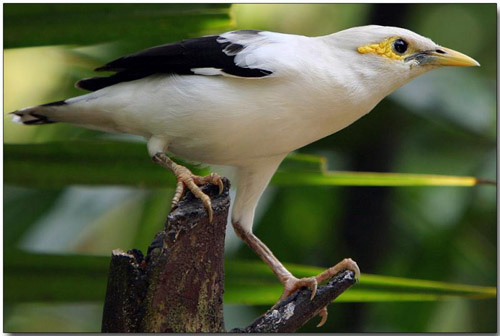
Bali Starling Bird


Animal Eyes | Bali Starling Bird  | Bird species this one is one step species, these beautiful birds have the white color that makes your eyes shine when he saw, in Indonesia this bird was labeled as animals move, and until this bird has been given strict rules when hunting these animals, like know? The following report


at first glance looks similar to birds and bird starling Starling White Suren, Bali Starling Bird has special characteristics, which have white fur all over his body except at the tip of the tail and wings are colored black. Bali Starling bird's eye dark brown, the area around the eyelids are not hairy with dark blue, crested bird Bali Starling has a beautiful, good at sex on a male or female, has a leg Bali Starling is gray blue with 4 fingers (1 to 3 to the rear and front), part tapered with a length of 2-5 cm, with a distinctive form where at the top there is a flattened elevation upright. Beak color blackish gray with a yellow tip brown.

Bali Starling Bird First reported its discovery by Dr.. Baron Stressmann an ornithologist nationality British on March 24, 1911. On the recommendation Stressmann, Dr. Baron Victor Von Plessenn conduct advanced research (1925) and find the Bali Starling bird distribution ranging from Bubunan up with wide spread Gilimanuk with an estimated 320 km2.

Bali Starling (Leucopsar rothschildi) with the local name of Bali Starling, Curik White, White Bali starling is one of the animals that are endangered and endemic species that exist in Indonesia precisely in the island of Bali, with the broadest distribution among Bubunan Buleleng to Gilimanuk, but at this time confined to the West Bali National Park area exactly in the Cape Peninsula and the Great Dark Prapat Pahlengkong the habitat type of mangrove forest, beach forest, monsoon forest and savanna

Panda


The Life of Animals | Panda | maybe in your house have the same doll with these animals, because usually the girls are very fond of this animal because of its cute, the color is just adorable, want to know? The following report


The giant panda is a black and white bear living in temperate-zone bamboo forests of central China. As one of the rarest animals on the edge of extinction, it stands for the species endangered and conservation efforts to protect them.


Giant pandas once inhabited in lowland areas, but with the development of farming and forestry, they have been forced to mountains of Sichuan, Shaanxi, and Gansu. 


Giant pandas prefer to live in broadleaf and coniferous forests with dense bamboos, at altitude between 5,000 and 10,000 feet, which areas are bathed all year around by mist and rain.


A giant panda looks like the bear in shape. It has a white coat apart from the black near ears, eye patches, muzzle, legs, and shoulders. Some scientists say that such coloring offered effective camouflage when they were in shade-dappled snow and rock surroundings. The panda's coat helps to keeps warm. Giant pandas have molar teeth and a large jaw for chewing bamboo. Many people may think the animal cute, but a giant panda can be dangerous as any other type of bear.


About the size of the American black bear, the giant panda can reach four to six feet tall. Males are larger than females. The wild male panda can weigh up to 250 pounds. Females rarely reach 220 pounds.


The giant panda is listed by the World Conservation Union's (IUCN's) Red List of Threatened Animals as an endangered species.  About 1,000 pandas live in the wild, about 140 in zoos or breeding centers, mostly in China. Scientists don't know yet the natural life of pandas that live in the wild conditions, but they are sure they have a shorter life than those kept in artificial conditions. Chinese scientists have reported zoo pandas of 35 years old.


A wild giant panda lives almost exclusively on bamboo. On very rare occasions they also eat grasses and small rodents or musk deer fawns. In zoos, the diet of giant pandas includes bamboo, sugar cane, gruel, carrots, apples, sweet potatoes, and a high-fiber biscuit specially made for them.


Adult giant pandas are often solitary. But they periodically communicate with each other with scent marks and sounds. Babies stay with their mothers for one and a half years to three years.
Detail: Panda

Affenpinscher

  
The Life of Animals | Affenpinscher | dog this one does seem scary because it has black around his body. black eyes are all black, but all that is wrong, because these dogs are very popular among women rather than creepy, but adorable, of acting, its shape, and others, want to know the following report?


The Affenpinscher is a small dog with a shaggy, wiry-type coat. The hair on the face is longer than the rest of the body giving it a distinct look. It is a smaller version of a working terrier and is not a delicate dog. It has a square-body, with a moderately broad, deep chest. The head is round with a pronounced stop, which is the transition area from the backskull to the muzzle. The lower jaw is undershot, and broad enough for the lower teeth to be straight and even, protruding below the dog's short nose. The prominent, round eyes are black. The neck is short and arched and the limbs are straight and well boned. The tail is carried high and docked to two-thirds its length. The hairy ears are customarily docked, pointed and erect, however some countries have banned docking of animal's tails and ears. The coat is usually black or dark gray, but can also come in lighter gray, silver, red, or black and tan. The undercoat is slightly curly.

The Affenpinscher has a terrier-like personality. They tend to get along with other dogs and pets especially when they are raised with them. They are busy, bold, inquisitive and stubborn, but they also love to monkey around, being playful and mischievous. A lively sharp-witted, little dog that is courageous and confident. A fearless defender, the Affenpinscher will quickly become an authoritarian, if owners do not give the proper rules, boundaries, limitations and constantly be this dogs pack leader. It is very affectionate and amusing. This friendly little dog enjoys being with its family. It needs consistent, firm training. Make sure there is some variety in the training so the dog does not become bored. They learn commands very quickly. Some may be difficult to housebreak. They are not recommended for very young children, simply because most people who own the breed treat them like a small dog, lacking the proper pack leadership, causing negative behaviors to come out in the dog. Children should be taught how to properly handle a dog. Owners need to consistently be the dog's pack leader to avoid the tenancy to guard their food and toys. They like to hike and go camping. Without leadership, it may unwisely challenge large dogs and other large animals. They tend to bark and even climb. This little dog does best with a family who likes entertainment and has a very good sense of humor. Any dog who displays growling, snapping or biting, has a lacking in pack leadership. These issues can be corrected as soon as the humans take control back from the dog. 

Height: 10-15 inches (25-38 cm.)W eight: 7-8 pounds (3-3.36 kg.)Some are prone to fractures, slipped stifle, PDA (patent ductus arteriosus), open fontanel and respiratory problems in hot weather.The Affenpinscher is good for apartment life. They are very active indoors and will do okay without a yard. These dogs are sensitive to temperature extremes. Overly warm living conditions are damaging to  the coat.The Mi-Ki need a daily walk.  While out on the walk the dog must be made to heel beside or behind the person holding the lead, as in a dog's mind the leader leads the way, and that leader needs to be the human. Play will take care of a lot of their exercise needs, however, as with all breeds, play will not fulfill their primal instinct to walk. Dogs who do not get to go on daily walks are more likely to display behavior problems. They will also enjoy a good romp in a safe open area off lead, such as a large fenced in yard. Teach them to enter and exit door and gateways after the humans. The Affenpinscher's harsh coat should never be clipped short because this ruins the coat for many years. It should be brushed and combed weekly and it may be necessary to pluck it. A dog-trimming specialist usually does this but it is possible to learn how to do it yourself. Show dogs require stripping. Hair sometimes grows in the corners of the eyes, causing irritation; they should be dealt with promptly. This breed sheds little to no hair.

No exact data about the Affenpinscher's origin exists, but it is one of the most ancient of the toy breeds. It is certainly related to the Brussels Griffon and probably to the terrier. It's named "Monkey Dog" because of his monkey-like facial structure and expression, which reminds one of a monkey. It is believed that the Affenpinscher originated in Germany, and the name Affenpinscher translated from German is "Monkey Terrier". It is believed that the first Affenpinschers were larger in size as they were farm dogs who worked as ratters. The Affenpinscher was miniaturized and became a house pet during the 18th and 19th centuries. It is still a ruthless hunter of mice and an outstanding watchdog. Today the Affenpinscher is primarily a companion dog. The Affenpinscher was admitted to the American Kennel Club's studbook in 1936.

Abyssinians


The Life of Animals | Abyssinians | a cat that may often be encountered in Indonesia and globally, these cats originally came from Ethiopia. These cats have the form of a very beautiful and captivating. from the eyes and the color has a typical cat in her body, want to know? The following report?


The Abyssinian breed of cat is believed to be originated from an Egyptian cat family. This domesticated breed was taken from Egypt to England by a British soldier. The Abyssinian breed has the characteristics of Zula and Tabby breeds. The Abyssinian is one of the most popular shorthair breeds of cats in United States of America.


Talking about the physical characteristics, The Abyssinian has a medium length body with well-developed muscles. The bone structure is fine and has slender legs in proportion to the body. Other characters are – long tail with tapering at point, small and oval paws, broad cup shape ears and an M shaped marking in the fur on the forehead. One of the beautiful characteristics of this breed of cat is that it has almond shaped eyes with either of gold, green, hazel or copper color which fit perfectly into the broad and wedge shaped head.


The coat is very fine, short and close lying. Three four colored bands are present along with one main base color. In the Abyssinian, back of the hinds and the feet are black in color. One more color which is popular is the Sorrel having a yellowish-brown base, with chocolate brown ticking. In the recent years, Blue Abyssinians are becoming very popular due to the light-beige base color along with blue ticking, paw pads and backs of the legs. The Silver Abyssinians (not recognized by the Cat Fanciers Association) has pure silvery white with markings varying from black, blue, warm dark cream and cinnamon. ther rare colored Abyssinians are Cream, the Tortoiseshell, Chocolate, Red and Lilac.


The Abyssinian is from the intelligent and extrovert breed of cats. They are always laying and exploring new things but they are sensible enough to avoid any unnecessary risks. They are attention seekers and if they are deprived of that then they can get into depression. Abyssinians go well with other cats but they do not compromise with their space. They may not be considered as a perfect lap cats but still they are one of the most popular breeds in the US.
Older Post ►
eXTReMe Tracker
 

Copyright 2011 ANIMALS dazzling is proudly powered by blogger.com