Showing posts with label Wolf. Show all posts

Great Plains Wolf

  
The Life of Animals | Great Plains Wolf | The Great Plains wolf (Canis lupus nubilus), also known as the Buffalo wolf, is the most common subspecies of the gray wolf in the continental United States. Like all wolves, the Great Plains wolf is a very social animal that communicates using body language, scent marking and vocalization with an average pack size of five to six wolves.


The territory size for the Great Plains wolf depends on the type and density of prey. The historic range of the Great Plains wolf was throughout the United States and the southern regions of Canada. In Wisconsin and Michigan, the Great Plains wolf was eradicated by the mid- 1960s. 


In 1974, the Great Plains wolf in the Great Lakes region became fully protected as an endangered species. By 1978, Minnesota's wolf population had increased enough that the wolf was reclassified as threatened in Minnesota. The estimated population for Great Plains wolves for 2004 in the United States was over 3,700 wolves. Minnesota 3,020 


Eastern Wolf

  
The Life of Animals | Eastern Wolf | The Eastern Wolf (Canis lycaon), also known as Eastern Canadian Wolf or Eastern Canadian Red Wolf, may be a subspecies of gray wolf (Canis lupus lycaon) or a distinct species of canid native to the eastern part of North America since the Pleistocene era It seems to be closely related to the Red Wolf. Many names were proposed, including the Eastern Wolf, Eastern Gray Wolf, Eastern Timber Wolf and Algonquin Wolf, although Eastern Wolf has appeared to gain the most recognition.


Eastern Wolf was recently recognized as a potentially distinct species, but closely related to red wolf Some authors disagree and the status as a distinct species is not official. The Eastern Wolf is smaller than the Grey Wolf and has a grey-reddish coat with black hairs covering the back and sides of the thorax. The mtDNA analysis confirms that eastern wolf belonged to an ancient form of primitive wolf (with red wolf) originating some 750,000 years ago in the eastern part of North America (Nowak 1979, 1992). On March 31, 2010, a presentation by Ontario Ministry of Natural Resources research scientist Brent Patterson outlined key findings about the Eastern Wolf (and coyotes): Most coyotes in Eastern Ontario are wolf-coyote hybrids; wolves in Algonquin Park are, in general, not inter-breeding with coyotes; and the buffer zone around Algonquin Park is a great success with mortality rates down and populations remaining stable.


Proponents of distinct species designation believe that the Eastern Canadian Wolf is just the remnant northern range of a once continuous range of a native canid - the Eastern wolf (E.C. w & Red Wolf). Unlike the Gray Wolf, the Eastern Wolf in Algonquin Park has never been recorded with an all-black or all-white coat (wolf research in Al. P. cited 2008). Eastern wolf mainly exist in Algonquin Park in Canada-USA border. The Eastern Wolf is smaller than the Gray Wolf. The Eastern Wolf is also skinnier than the Gray Wolf and has a more coyote-like appearance. This is because wolves and coyotes often mate and breed wolf/coyote hybrid pups in the park. 


The Canadian Parks and Wilderness Society states: "Hybridization with coyotes has historically been a precursor to the decline of Eastern wolf populations. Grey wolves will attack, kill or drive out coyotes if they find them, but recent studies by John and Mary Theberge suggest that Algonquin wolf males mate and accept coyote females. John Theberge states that, because coyotes are smaller than wolves, that female wolves would be less likely to accept a smaller mate.


However, on March 31, 2010, a presentation by Ontario Ministry of Natural Resources research scientist Brent Patterson outlined key findings about the Eastern Wolf (and coyotes): Mostcoyotes in Eastern Ontario are wolf-coyote hybrids; wolves in Algonquin Park are, in general, not inter-breeding with coyotes; and the buffer zone around Algonquin Park is a great success with mortality rates down and populations remaining stable In Canada, exact numbers of Eastern Canadian Wolves are unknown. In Algonquin wolves often travel outside the park boundaries, and enter farm country where some are killed. The Eastern Wolf preys on white-tailed deer, moose, lagomorphs, and rodents including beaver, muskrat, and mice.

Eurasian Wolf

  
The Life of Animals | Eurasian Wolf | The Eurasian Wolf (Canis lupus lupus), also known as the, European, Common or Forest Wolf is a subspecies of grey wolf which has the largest range among wolf subspecies and is the most common in Europe and Asia, ranging through Mongolia, China, Russia, Scandinavia, Western Europe and the Himalayan Mountains. Compared to their North American cousins, Eurasian wolves tend to have longer, more highly placed ears, narrower heads, more slender loins and coarser, tawnier coloured fur. Compared to Indian wolves, Eurasian wolves are larger, and have longer, broader skulls. In Europe, wolves rarely form large packs like in North America, as their lives are more strongly influenced by human activities. Because of this, Eurasian wolves tend to be more adaptable than North American wolves in the face of human expansion.


Comparative studies on the Mitochondrial DNA of various wolf subspecies have shown that the European line of wolves originated over 150,000 years ago, making them around the same age as North American wolves, but significantly younger than Asiatic subspecies.Comparative studies on the Mitochondrial DNA of various wolf subspecies have shown that the European line of wolves originated over 150,000 years ago, making them around the same age as North American wolves, but significantly younger than Asiatic subspecies.


The size of Eurasian wolves is subject to geographic variation with animals in Russia and Scandinavia being larger and bulkier than those residing in Western Europe, having been compared by Theodore Roosevelt to the large wolves of north-western Montana and Washington. One wolf killed in Romania was recorded to have weighed 72 kilograms (158 pounds) Italian wolves, excepting the tail, body length ranges between 110–148 cm, while shoulder height is 50–70 cm. Males weigh between 25–35 kg (55-77 lbs) and rarely 45 kg (99 lbs) The now extinct British wolves are known to have reached similar sizes to Arctic wolves.


The guard hairs of the shoulder measure 90 mm, but can reach 110–130 mm Wolves in Southern Europe tend to be more richly coloured than their northern relatives. Black coloured wolves (which result from wolf-dog hybridisation) are rarer in Eurasia than in North America due to wide spread reduction in wolf numbers preventing wolves from interacting with dogs, though currently 20-25% of Italy's wolf population is composed of black animals. Because of widespread habitat reduction and displacement of large prey, European wolf packs are usually smaller than North American ones, and generally form territorial ranges of 100–500 km², as opposed to North American packs whose territories encompass 80-2,500 km². Because of their longer association with urban civilisations, Eurasian wolves tend to be more adaptable than North American wolves in the face of human expansion; Southern European wolves successfully live in areas with much higher human densities than what North American wolves will tolerate. Unlike wolves in North America, many Eurasian wolf populations are forced to subsist largely on livestock and garbage in areas with dense human activity, though wild ungulates such as moose, red deer, roe deer and wild boar are still important food sources in Russia and the more mountainous regions of Eastern Europe. In the Białowieża Forest, wolves primarily feed on red deer; 75% of red deer mortality there was attributed to wolf predation. Although properly regulated wolf harvests and control have been largely accepted as compatible with maintaining wolf numbers to economically acceptable levels, overhunting and poaching are recognised as the main limiting factor in European wolf populations. With the exception of Russia, European wolf populations number 18,000-25,000.


Mexican Wolf


The Life of Animals | Mexican Wolf | The Mexican Wolf is the smallest Gray Wolf subspecies present in North America. Until recent times, the Mexican Wolf ranged the Sonoran and Chihuahuan Deserts from central Mexico to western Texas, southern New Mexico, and central Arizona. Hunters also hunted down the wolf because it killed deer. Trappers and private trappers have also helped in the eradication of the Mexican Wolf. (Note that recent studies completed by genetics experts show evidence of Mexican Wolves ranging as far north as Colorado). In 1976, the Mexican Wolf was declared an endangered subspecies and has remained so ever since. Today, an estimated 340 Mexican Wolves survive in 49 facilities at the United States and Mexico.


In March 1998, the United States Fish and Wildlife Service (USFWS) began reintroducing Mexican Wolves into the Blue Range area of Arizona. The overall objective of this program was to reestablish 100 Mexican Wolves in the Apache and Gila National Forests of Arizona and New Mexico by 2008.


On March 30, 1998, government biologists released 11 gray wolves 3 adult males, 3 adult females, 3 female pups and yearlings and 2 male pups from 3 chain-link acclimation pens within the 18,130 square kilometres (7,000 sq mi), federally designated Blue Range Wolf Recovery Area in east-central Arizona.


In February 2010, three captive Mexican Wolves living in the Wildlife Science Center in Forest Lake, Minnesota escaped from their pen after it was pried open by unknown individuals. The Center is the third largest breeding and host facility for Mexican gray wolves in the United States


Arabian Wolf

  
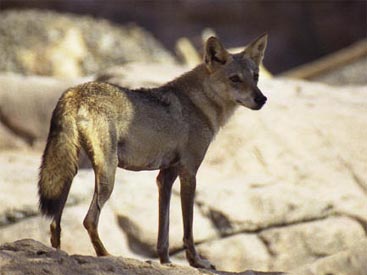
The Life of Animals | Arabian Wolf | The Arabian wolf (Canis lupus arabs) is a subspecies of Gray Wolf which was once found throughout the Arabian Peninsula, but now only lives in small pockets in Southern Israel, Southern and western Iraq, Oman, Yemen, Jordan, Saudi Arabia, and probably in some parts of the Sinai Peninsula in Egypt.


The Arabian wolf is a small, desert adapted wolf that stands at around 26 inches shoulder height and weighs an average of 40 pounds Their ears are proportionally larger in relation to body size when compared to other species, an adaptation needed to disperse body heat. The winter coat is long, though not as long as northern subspecies  Arabian wolves are unique among grey wolves due to the middle two toes of their paws being fused, a trait originally thought unique to the African Wild Dog  It is distinguished from the Indian Wolf by its paler fur, smaller size and proportionally smaller head


Arabian wolves will attack and eat any domestic animal up to the size of a goat. Arabian wolves also feed on hares, rodents, ungulates, and any carrion they can find. In Israel, there are between 100 and 150 Arabian wolves all over the Negev and the Arava. 


Tundra Wolf


The Life of Animals | Tundra Wolf | The Tundra Wolf (Canis lupus albus) is a subspecies of Gray Wolf native to the tundra and forest zones in the European and Asian parts of Russia and Kamchatka. Although often written to be larger than forest wolves, this is untrue, as heavier forest wolves have been recorded. Average weight for males is 40-49 kg (88-108 lb). Females average 36.6-41 kg (81-90 lbs).


The fur is very long, dense, fluffy and soft. The top hairs are 150-160 mm, the guard hairs 80-150 mm and the underfur 70 mm. The fur is usually light and grey in colour. 


It rarely forms permanent territories, travelling 200-300 km annually to accompany reindeer migrations. Reindeer losses to tundra wolves can be considerable for the Nenets people, who rely on them for subsistence; in the Yamalo-Nenets Autonomous Okrug, 1708 reindeer were killed by tundra wolves in 1951, and 7048 others were scattered. In the decade between 1944-1954, tundra wolves killed 75,000 reindeer


Arctic Wolf


The Life of Animals | Arctic Wolf | The Arctic Wolf (Canis lupus arctos), also Called Polar Wolf or White Wolf, is a species of mammal of the Canidae family, and a subspecies of the Gray Wolf. Arctic Wolves inhabit the Canadian Arctic, Alaska and the northern parts of Greenland. The Arctic Wolf inhabits the northern part of Greenland, the Canadian Arctic and parts of Alaska. Arctic wolves live on the islands of the Canadian Arctic, and the north coast of Greenland, roughly north of 70 ° North latitude.


The Arctic Wolf can withstand the arctic weather. Arctic Wolves usually travel in packs of 2 to 20. They live in small family groups: a breeding pair (alpha male and female) and Their pups. Lone Arctic Wolves are young males have left That Their pack to seek Their own territories. Having found an abandoned territory, a lone Arctic Wolf Will claim it by marking the territory with its scent, then gather other lone wolves into its pack. When the female is pregnant, She leaves the pack to dig a den to raise her pups. Like all wolves, Arctic Wolves hunt in packs, preying on caribou and muskoxen Mainly, but also Arctic Hares, seals, Ptarmigan and lemmings, and Smaller animals Such as Waterfowl To eat rodents Their They must pick up the scent and find the entrance to Their tiny dens to flush them out.


Wolves almost never attack Humans. Adult wolves have 42 teeth, Their main weapon in hunting. They swallow food in large chunks, barely chewing it. Wolves can eat up to 20 pounds (9 kg) of meat at one meal. When They return from the hunt, wolves regurgitate some of the food for the hungry pups

Due to the Arctic's permafrost soil and the difficulty it poses for digging dens, Arctic Wolves Often use rock outcroppings, caves or even shallow depressions as dens instead. Other wolves in the pack may take care of the mother's pups until She returns with food.

Gray Wolf


The Life of Animals | Gray Wolf | Gray wolf is the largest on the species. they can be found in diverse habitats in most of North America. These animals survived the ice age and it is estimated are the ancestors of domestic dogs. But they could not survive the cruelty of human


Wolves are predatory animals. They hunt down big animal like the bison. In some other area, wolves also feed on salmon fish.


Long time ago (ten thousand years ago), human hunt down animals for the meat. Leaving large pile of bones outside the house, wolves start to come and grab anything they can eat. This is very normal because cannibalism exist among wolves. So from a predator wolf, it slowly turns into a scavenger wolf. Having free meal, left by the human. This made those wolves eventually rely on human.


Later on, wolves become closer and closer to human. That's why the wolves slowly changes into dogs. During this domestication, the fur colour of the wolves change after generation of breeding. Because they don't need the fur colour to camouflage to their surroundings (surprise attack purpose) anymore.


Detail: Gray Wolf
Older Post ►
eXTReMe Tracker
 

Copyright 2011 ANIMALS dazzling is proudly powered by blogger.com